

Europe Cybersecurity Market to Hit USD 165.73 Billion by 2034 Driven by Escalating Cyber Threats and 8.2% CAGR Growth
Europe Cybersecurity Market Report
IMARC Group's Latest Research Reveals a CAGR of 8.2% from 2026-2034, with Services and BFSI Segments Leading the Charge
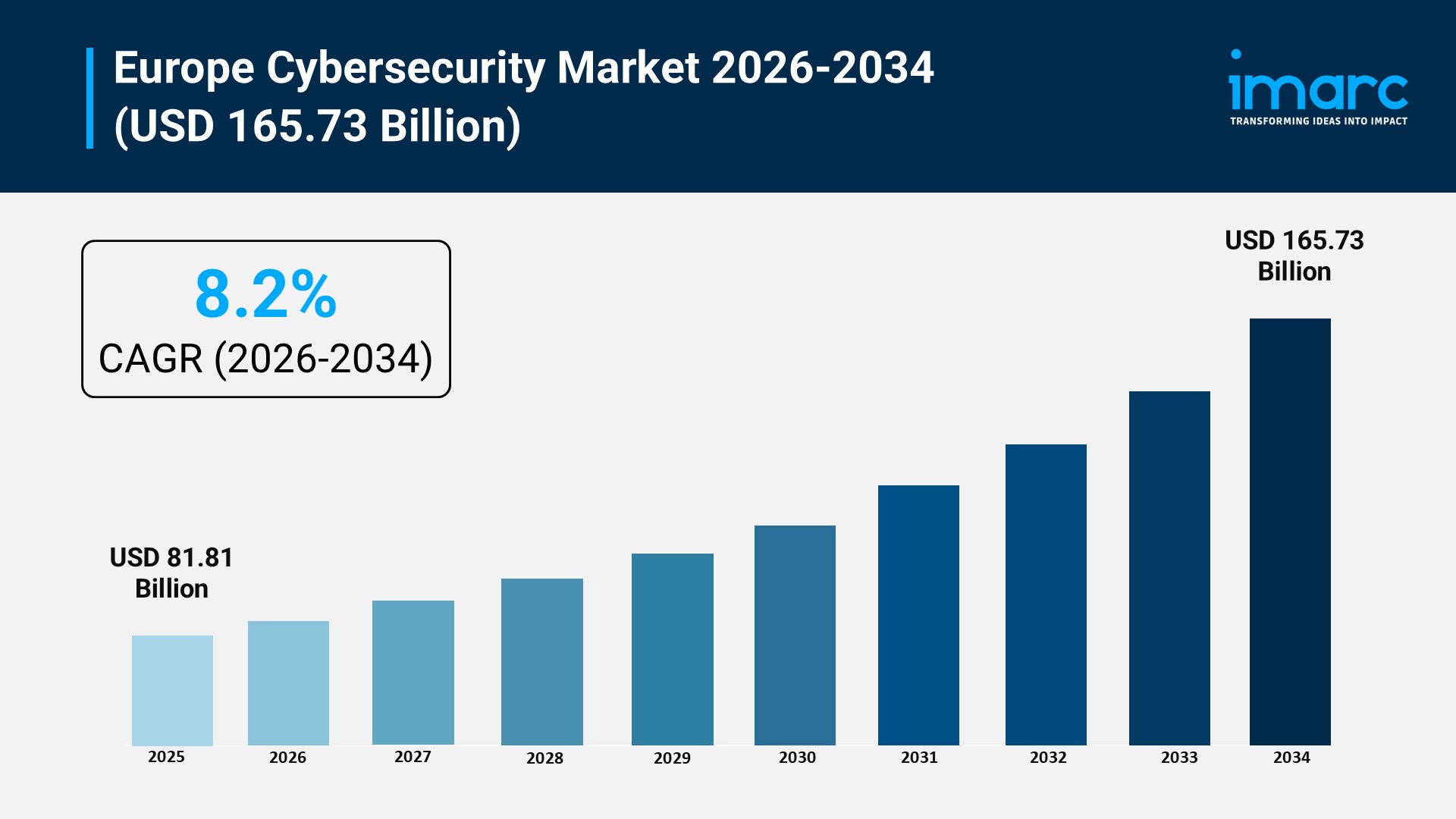
LONDON, LONDON, UNITED KINGDOM, February 23, 2026 /EINPresswire.com/ -- Europe's cybersecurity sector is entering a decade of rapid and sustained expansion. According to a new market intelligence report by IMARC Group, the Europe Cybersecurity Market - valued at USD 81.81 Billion in 2025 - is projected to surpass USD 165.73 Billion by 2034, registering a compound annual growth rate (CAGR) of 8.2% during the forecast period 2026-2034.As ransomware operations target nearly twenty-two percent of global extortion victims and AI-supported phishing campaigns account for over eighty percent of social engineering activity, European organizations face an urgent imperative to invest in advanced cybersecurity capabilities. Regulatory frameworks including the NIS2 Directive and the Digital Operational Resilience Act (DORA) are transforming cybersecurity from discretionary spending into compulsory investment, driving sustained market momentum across all sectors.
Request for a sample to get a detailed understanding about the market: https://www.imarcgroup.com/europe-cybersecurity-market/requestsample
What Is Driving Europe’s Cybersecurity Market Boom?
The report identifies three core forces reshaping Europe’s cybersecurity landscape:
• Escalating Regulatory Pressure: The NIS2 Directive now mandates compliance across eighteen critical sectors, affecting approximately thirty thousand companies in Germany alone. DORA enforces comprehensive ICT-risk management across all financial institutions in the EU, turning regulatory compliance into a permanent cybersecurity spending floor.
• Surging AI-Powered Threats: Nation-state adversaries and financially motivated cybercriminals increasingly deploy artificial intelligence to automate reconnaissance, generate deepfake content, and evade traditional detection systems. Germany spent EUR 11.2 billion on cybersecurity in 2024, with 13.8% annual growth, while the broader European market grew thirteen percent in the first half of 2025 driven by AI-related threats.
• Digital Transformation and IoT Expansion: Industry 4.0 initiatives are connecting thousands of sensors, actuators, and operational technology devices to enterprise networks, exponentially expanding attack surfaces. The deployment of 5G networks further accelerates IoT adoption, creating new security requirements across manufacturing, healthcare, and energy sectors.
Key Market Insights at a Glance
The following highlights the leading segments by category based on 2025 market share data:
• Component - Services: 54.08% market share, driven by widespread reliance on managed security providers and professional consulting expertise.
• Deployment Type - On-Premises: 58.12% market share, reflecting data sovereignty requirements and stringent regulatory compliance priorities.
• User Type - Large Enterprises: 70.1% market share, supported by substantial cybersecurity budgets and comprehensive regulatory obligations.
• Industry Vertical - BFSI: 24.15% market share, driven by stringent financial regulations and critical infrastructure protection requirements.
• Country - Germany: 22% market share, propelled by a robust industrial base and proactive security adoption across public and private sectors.
Detailed Segment Analysis
1. By Component: Services Dominate with 54.08% Share
Organizations across Europe increasingly rely on specialized managed security service providers (MSSPs) to address cybersecurity challenges that exceed internal team capabilities. Over seventy percent of UK small businesses utilize external providers for threat detection and incident response, underscoring the critical role of the services segment. Professional services encompassing consulting, implementation, and compliance management capture significant share as NIS2 mandates drive demand for risk assessments, zero-trust architecture design, and post-quantum cryptography roadmaps.
The solutions segment, which spans Identity and Access Management (IAM), Infrastructure Security, Governance, Risk and Compliance, Unified Vulnerability Management, and Data Security and Privacy, provides the foundational technology layer that service providers deploy and manage on behalf of enterprise clients.
Connect for a details segmentation analysis, ask for analyst: https://www.imarcgroup.com/request?type=report&id=9558&flag=C
2. By Deployment Type: On-Premises Leads at 58.12%
Data sovereignty requirements and regulatory compliance priorities sustain strong demand for on-premises cybersecurity deployments. Germany demonstrates particularly robust adoption, with over eighty percent of enterprises deploying firewalls and intrusion detection systems in controlled environments. Defense and public-sector workloads mandate full hardware control to meet security protocols that prohibit external data processing.
Cloud-based deployments are accelerating rapidly, capturing significant revenue growth as enterprises embrace elasticity and continuous security updates. Hybrid architectures are demonstrating the fastest growth trajectory, enabling organizations to retain sensitive data processing internally while accessing global threat intelligence networks. In 2024, Microsoft announced a significant expansion of its cloud infrastructure across European regions to support surging demand.
3. By User Type: Large Enterprises Command 70.1% Share
Large enterprises maintain dominant market share driven by substantial cybersecurity budgets and comprehensive regulatory compliance obligations. These organizations face sophisticated threat actors targeting intellectual property, customer data, and operational infrastructure, necessitating multi-layered defense mechanisms spanning network security, endpoint protection, and identity management. NIS2 and DORA impose direct accountability on management bodies for cybersecurity compliance, elevating security investments to boardroom-level priorities.
Small and medium enterprises represent the fastest-growing user segment as expanded NIS2 coverage brings mid-market firms previously exempt from mandatory requirements into compliance scope. Managed security service providers increasingly tailor offerings to SME requirements, delivering enterprise-grade protection through scalable subscription models.
4. By Industry Vertical: BFSI Leads with 24.15% Share
Banking, financial services, and insurance organizations prioritize cybersecurity investments to protect critical infrastructure and maintain customer trust. European banks accounted for forty-six percent of cybersecurity incidents analyzed by ENISA, highlighting the sector’s vulnerability to sophisticated attacks. DORA mandates enforce comprehensive ICT-risk management frameworks and third-party oversight requirements, making cybersecurity compliance a regulatory imperative across all financial institutions.
Key industry verticals covered in the report include:
• BFSI (24.15% - Largest): Regulatory-driven investment in identity protection, behavioral analytics, and continuous threat exposure management programs.
• Defense/Government: Critical infrastructure protection against state-sponsored adversaries; EU Digital Europe Programme allocates €1.3 billion for essential digital technologies through 2027.
• Healthcare (High Growth): Medical device security and clinical network protection gaining urgency; ransomware attacks on hospital systems represent among the most costly cyber incidents.
• IT & Telecom: 5G network security and cloud infrastructure protection driving accelerated investment.
• Manufacturing: Operational technology (OT) security for Industry 4.0 environments protecting against industrial espionage and supply chain attacks.
• Energy: Grid modernization and renewable energy infrastructure expanding attack surfaces requiring specialized ICS/SCADA security solutions.
Country Spotlight: Germany Leads Regional Market
Germany maintains regional market leadership with a 22% share, reflecting its strategic importance as Europe’s largest economy and manufacturing powerhouse. With EUR 11.2 billion in cybersecurity spending in 2024 and 13.8% annual growth, Germany’s robust investment reflects both the severity of threats targeting its industrial base and the proactive adoption of advanced security frameworks. NIS2 implementation will affect approximately thirty thousand German companies, creating a significant new demand wave across mid-market enterprises.
Other major markets covered include:
• United Kingdom: Advanced regulatory environment and strong financial services sector driving cybersecurity innovation; AI Code of Practice released in 2025 establishes secure AI deployment standards.
• France: Government-led cybersecurity investments and strong defense industrial base supporting market growth.
• Italy & Spain: Accelerating NIS2 adoption and increasing ransomware incidents driving mid-market security investments across Southern Europe.
Key Market Trends Shaping the Forecast Period
• AI Integration in Threat Detection: Machine learning technologies demonstrate proven malware detection capabilities, while generative AI models accelerate vulnerability discovery and threat analysis. Autonomous threat operations eliminate manual bottlenecks by continuously scanning for emerging threats.
• Cloud and Hybrid Security Architectures: Hybrid deployment models balance operational flexibility with data sovereignty requirements. Financial institutions are piloting quantum-secure metro networks maintaining encryption keys on-premises while routing telemetry to analytics engines in sovereign clouds.
• Market Consolidation via M&A: Quarterly transaction volumes in Q4 2024 reached record highs, with security operations emerging as the largest subsector for acquisition activity. In October 2024, Thoma Bravo completed an all-cash acquisition of Darktrace, the UK-based AI cybersecurity solutions provider, expanding its enterprise software portfolio.
Challenges the Industry Must Address
• Cybersecurity Skills Shortage: A significant number of firms report new hiring needs under NIS2 compliance mandates, yet available talent pools prove insufficient to meet surging demand for security operations center analysts, penetration testers, and compliance specialists.
• AI-Enabled Attack Sophistication: Threat actors increasingly leverage AI and machine learning to automate reconnaissance, enhance phishing campaigns, and evade traditional detection mechanisms, with AI-supported attacks representing over eighty percent of social engineering activity.
• Supply Chain and Third-Party Risk Complexity: Sixty-seven percent of European outsourcing contracts involve sub-outsourcing to external service providers, creating multi-tier dependencies with limited visibility. Sixty-three percent of supplier incidents result in sensitive data exposure.
Recent Developments
• December 2025: Capgemini was selected by the European Commission’s Directorate-General for Digital Services to deliver comprehensive cybersecurity services to public entities across the EU under the MC17 FREIA Cyber Framework Contract - a multi-million Euro, four-year deal protecting 71 European Institutions, Bodies, and Agencies.
• September 2025: Atos secured a major contract under the European Commission’s CLOUD II Dynamic Purchasing System for cybersecurity services, worth up to €326 million, representing one of the most significant cybersecurity service deals in European history.
• June 2025: Microsoft launched its European Security Program across all twenty-seven EU member states, introducing joint research programs focused on AI-cybersecurity challenges with initial investment supporting critical infrastructure protection and agentic AI security development.
About the Report
The Europe Cybersecurity Market Size, Share, Trends and Forecast by Component, Deployment Type, User Type, Industry Vertical, and Country, 2026–2034 report by IMARC Group provides comprehensive historical data (2020–2025), segmentation analysis, competitive landscape insights, and a forward-looking forecast through 2034.
The report covers 2 component categories (Solutions, Services), 2 deployment types (Cloud-based, On-premises), 2 user types (Large Enterprises, SMEs), 8 industry verticals, and 5+ country markets. Customization options are available, with 10% free customization included and 10–12 weeks of post-sale analyst support.
Get Access to the Report
Businesses, investors, and cybersecurity professionals looking to understand Europe’s evolving security landscape can access the full report at: www.imarcgroup.com/europe-cybersecurity-market
• Request a Free Sample Report
• Speak to an Analyst for Custom Insights
• Inquire Before Buying
About IMARC Group
IMARC Group is a leading global market research company providing data-driven insights and expert consulting services to businesses seeking to achieve their strategic objectives. With a multi-disciplinary team of industry experts, IMARC delivers thorough, reliable market intelligence across sectors including Technology & Media, Healthcare, Financial Services, Manufacturing, and more.
Elena Anderson
IMARC Services Private Limited
+1 201-971-6302
email us here
Legal Disclaimer:
EIN Presswire provides this news content "as is" without warranty of any kind. We do not accept any responsibility or liability for the accuracy, content, images, videos, licenses, completeness, legality, or reliability of the information contained in this article. If you have any complaints or copyright issues related to this article, kindly contact the author above.
